
Foreword
Walk into a franchised store on a Saturday in 2034 and the first thing that hits you is the quiet. Not empty. The place is busy. But the old noise is gone. No up bus circling the front door. No hold music bleeding out of a BDC. No manager trolling the floor for a turn, no customer stranded at a counter repeating her phone number, no long walk back to go see somebody's manager. The store runs like a clock that keeps its own time. Every name on the board today arrived already understood: who they are, what they drive, what they came in for, what they have already been told.
You will not find a salesperson here, and you will not find a service writer. Those jobs, as the industry knew them, are gone. In their place is a small bench of concierges, unhurried and startlingly well briefed, whose whole job is to make the last mile of a decision feel effortless. The woman taking delivery at noon settled the shape of her deal days ago, with her own AI, before anyone at the store was in the story. The concierge walking her through it already knows her trade, her nine years in the service lane, and that she is short on time, and spends the hour on the part no machine can touch: the walk-around, the real questions underneath the questions, the handshake.
The showroom is smaller and calmer than it was in 2026, and the busiest room in the building is the service drive, because that is where the durable money moved. None of that calm is an accident. Underneath it runs a system the store owns, holding everything it knows about every customer, humming in the background like the electrical panel behind the wall.
None of that exists yet. It is 2026, and your store still runs on the old assumptions: the up bus, the BDC, the tower, the vendor stack. But every piece of that picture is already in motion, and the distance between here and there is not technology. It is a set of decisions you are making this year, whether you realize you are making them or not.
Here is the fact that starts the clock. In early 2026, an AI shopping agent contacted 100 dealerships about the same vehicle. 92 responded within 24 hours. Only 33 provided a full out-the-door price. The agent kept every line item, compared all 100 stores in minutes, and never got tired. That is not a faster shopper. It is a different counterparty, and it is already working your market.
The 100-store study · early 2026
The agent kept every line item, compared all 100 stores in minutes, and never got tired.
Which brings me to the part nobody wants to hear. Almost every standard this industry treats as permanent is about to turn upside down. And "we'll catch up later," the sentence that was true through every prior wave, is finally false. There is no later.
Sacred cows, flipped
The dealer held the information advantage for a century; now the buyer's software knows the market better than your best desk manager. Location was the moat; an agent shops 500 miles as easily as five. More staff meant more throughput; now one sharp operator with agents behind her does the work of eight. F&I was where you sold. It is becoming where you prove. The DMS was plumbing; your data is now the whole business.
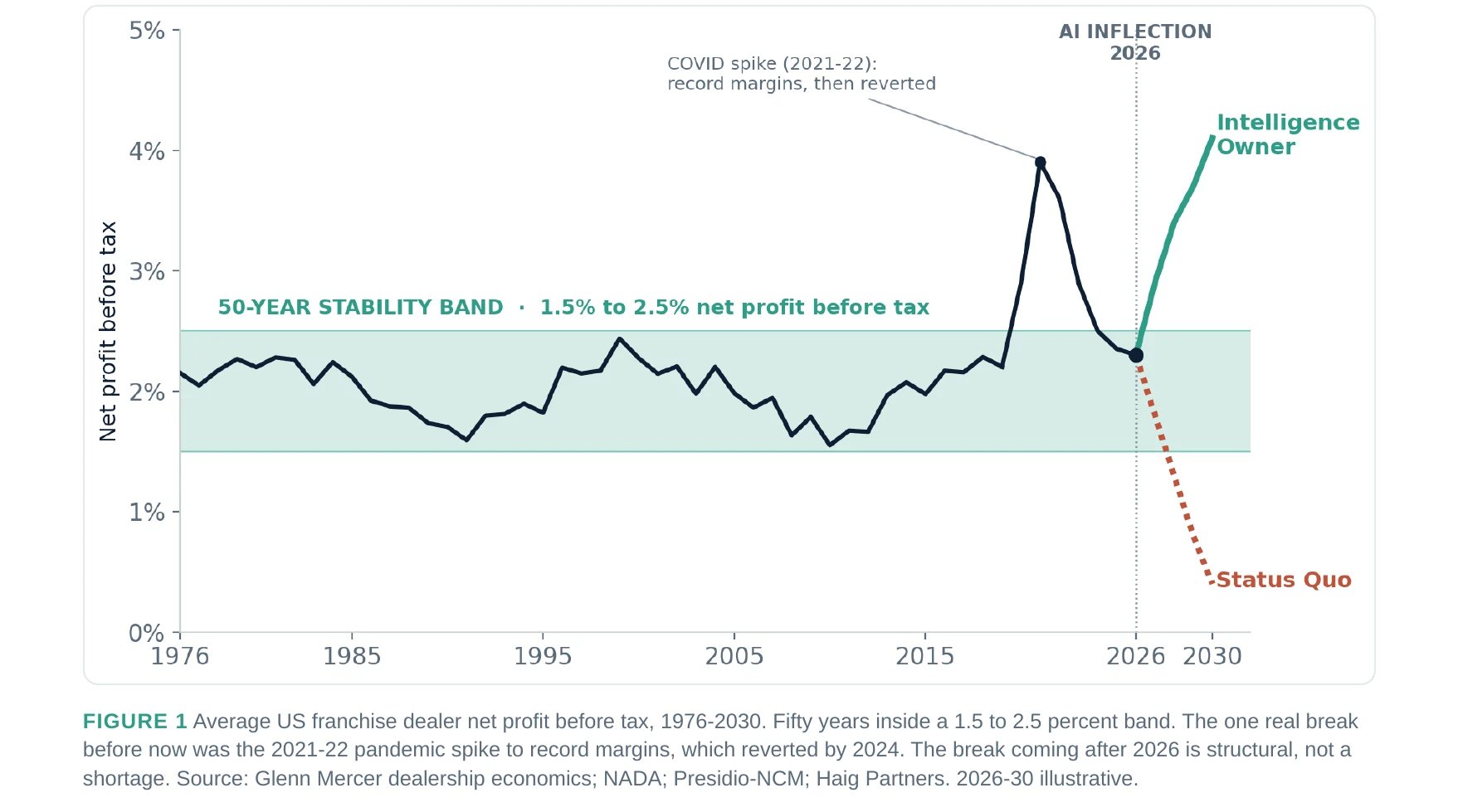
The 50-year miracle is about to break
There are roughly 16,990 franchised light-vehicle dealerships in the United States. For half a century, through oil shocks, the dot-com bust, and the Great Recession, the average one kept between 1.5 and 2.5 cents of every dollar it took in, and never went negative. Glenn Mercer's research documents it. The one real break in the pattern was the pandemic, and it is worth being precise about, because it is the exception that proves the rule.
In 2020 profit jumped about 43 percent. In 2021 it more than doubled, with the average store clearing north of $3 million pretax against roughly $1.3 million the year before, and net margins spiking to records well above the top of the band as inventory dried up. Then it reverted almost as fast as it came: down in 2022, off about 20 percent in 2023, and sliding back toward the old band by 2024. A shortage broke the band upward for two years, and the band pulled it right back.
The band is about to break again. This time it will not snap back, because the cause is not a shortage. The only open question is which direction it breaks for your store.
“Data is the foundation. AI is the multiplier.”
A multiplier on zero is zero. A multiplier on garbage is faster garbage. The winners of the next decade will not be the dealers who bought the most AI. They will be the ones who built an intelligence layer: a dealer-owned system that pulls the fragments out of the DMS, the CRM, the website, and the service drive, resolves them into one truthful picture of every customer and every vehicle, and puts that picture to work across the whole store. Agents are the software that does the work on top of that layer. Useful, even essential. Never the headline.
One disclosure. QoreAI is a data company. Our product, QoreCloud, is that owned intelligence layer. We get a dealer's data out of the third-party systems holding it captive and into a system of intelligence the dealer controls. Judge every claim in here the way you would judge a used car I was selling you. Kick the tires, run the numbers, hold me to the dates.
Why a scenario, not a forecast
Predictions about AI come in two useless flavors: vague ("AI will transform retail") and falsely precise ("38 percent of dealership jobs automated by 2030"). Neither one survives contact with a real Saturday. A scenario is different. It is a dated, year-by-year story with named people, specific numbers, and things going wrong.
Three rules govern what follows. First, the recommendation is a recommendation. The path our composite dealer takes is what I actually advise. Second, the downstream effects are predictions. Margins, headcount, OEM behavior, the shakeout years. I state them with dates so they can be wrong in checkable ways. Third, the failures are real. You will read a lock-in disaster and a compliance blowup in here, because a scenario that only shows success is marketing, and I did not write this to market to you.
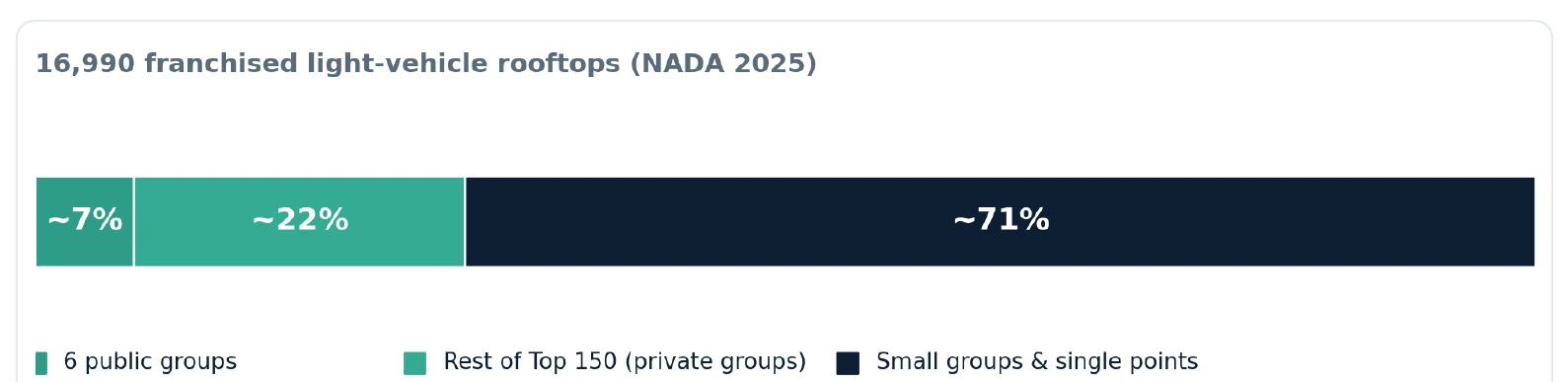
Our protagonist is a composite: Carver Ford-Lincoln of Marion, Ohio. Single rooftop, second generation, 64 employees, 118 new and 96 used in a good month. Dealer principal Elena Carver, 51, took the store from her father in 2019. I made her a single-point dealer on purpose. The six public groups control only about 7 percent of American rooftops, and the Automotive News Top 150 groups together own about 27 percent. Nearly three-quarters of this industry is small groups and single points. A path that only works for a 40-store group with a CTO is not a path. It has to work in Marion.
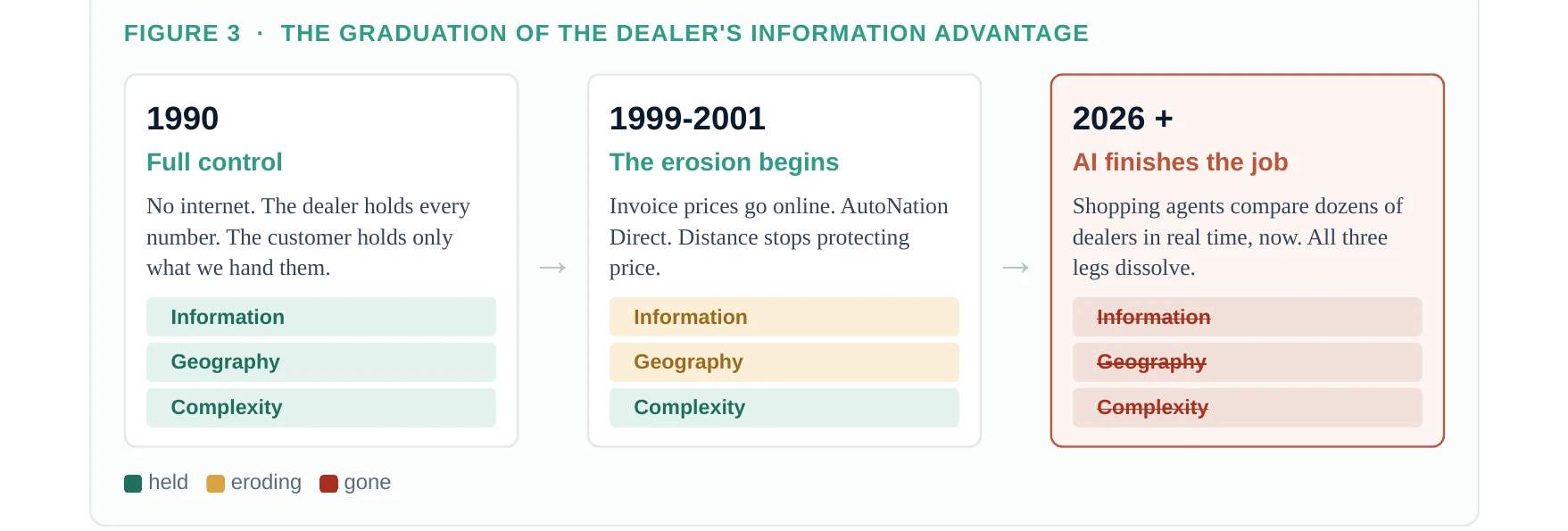
The graduation of the dealer's information advantage
The dealership's core product was never really the car. To understand what AI is taking, you have to be honest about what the store was actually selling.
1990: full control
In 1990, the desk held every number and the customer held none. Cost, holdback, incentives, auction values, payoff, rate: all of it lived on the dealer's side of the table. Strip away the nostalgia and the 1990 dealership sold three things. Information asymmetry. Geographic protection. Complexity. The car was almost incidental. Those three things, not the car, were the margin.
1999 to 2001: the internet starts the erosion
AutoNation Direct tried selling cars online. Invoice prices landed on websites any customer could reach from a den in Marion. Information asymmetry got cut roughly in half. Geographic protection weakened. Complexity held. That is why F&I gross went up over the next two decades while front-end gross went down. The internet also gave dealers a decade to respond. That was a mercy, and this next wave does not repeat it.
2026: AI finishes the job, and it is not waiting
Run the three legs through the 100-store study. Information asymmetry: gone, actually reversed, because the customer's software now knows the market better than most desks do. Geographic protection: gone, because an agent shops 500 miles as easily as five. Complexity: gone, because complexity is exactly the thing software eats first. All three legs, dissolved. Not over a decade. Over a couple of years, starting now. That is why the fifty-year band breaks. AI is not magic. It just removes the last of what the old dealership actually sold, and the buyer's side deployed it first.
The doom pieces stop there, and they miss the good news. The dealer is sitting on a new product, mostly unrefined: two or three decades of transactional truth about tens of thousands of local households. Who bought. Who serviced. Who declined which repair. Who has equity. Whose kid turns sixteen next spring. Unify that data, own it, and you have the raw material of the only durable advantage left: knowing your market better than any outside platform can. The dealers who refine it will replace the old asymmetry with a legitimate one. The dealers who leave it scattered across vendor systems will find out someone else refined it for them and is charging them by the month to see it.
“The dealership's first great asset was information the customer couldn't get. Its next great asset is intelligence about the customer that no platform can match.”
The shape-shifting OEM
The scenario has three obvious forces: the dealer, the customer's agent, and the vendors. There is a fourth, and the industry keeps talking about it in yesterday's terms. The OEM of 2035 is not the OEM of 1990 wearing a software badge. It is a different animal that changes shape roughly every three years across this decade, and a dealer who plans for only one of its shapes will get blindsided by the others.
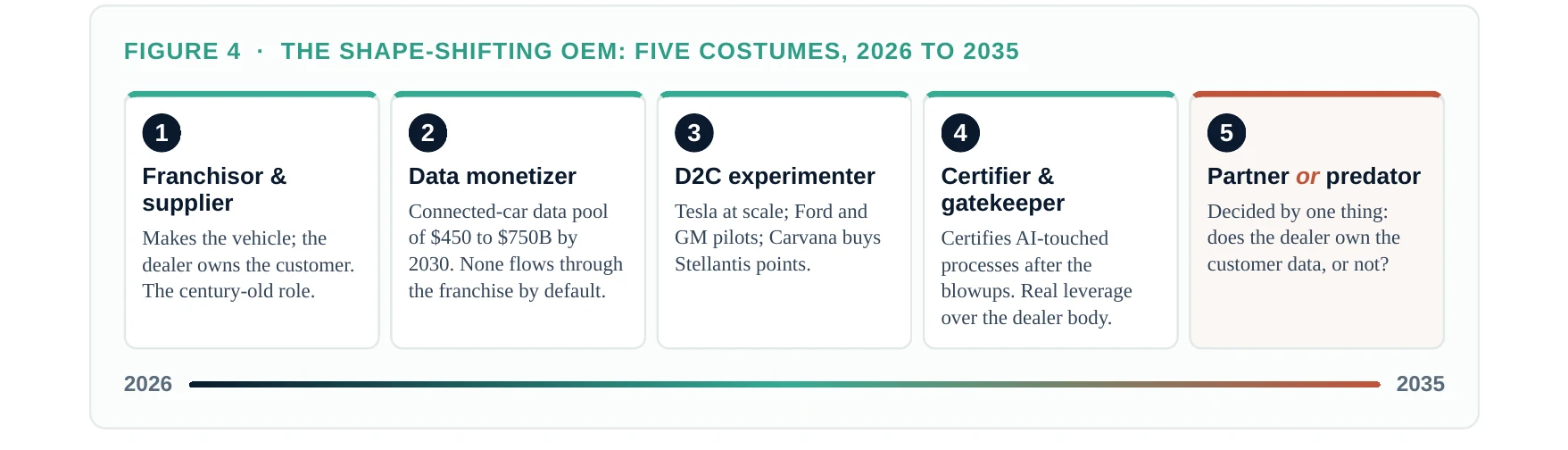
- Costume 1 · Connected-car data reseller (2026 to 2027). The OEM sits on the richest first-party dataset in the vehicle's life: telematics, in-car behavior, over-the-air update signals. It packages that data for insurers, cities, and advertisers, and it decides which slice, if any, the dealer sees. If your only view of the customer is your own store, you are already blind to two-thirds of the picture.
- Costume 2 · Subscription curator (2027 to 2028). Heated seats, driver-assist tiers, range unlocks. The OEM bills the customer directly on a monthly basis, and the dealer is neither in the transaction nor in the renewal loop. Revenue that used to flow through F&I now flows past it.
- Costume 3 · Demand-layer curator (2028 to 2029). The factory-direct configurator becomes the front door for a growing share of shoppers. The dealer becomes a fulfillment and delivery node on somebody else's funnel, unless the dealer is the local relationship the factory cannot replicate.
- Costume 4 · Compliance-layer operator (2029 to 2031). Burned by the 2027 to 2028 agent scandals, OEMs certify AI-touched processes: approved disclosure language, human sign-off points, audit-log standards. Certification is quiet gatekeeping. Certified stores get referred connected-car service leads. Uncertified stores get quietly re-flagged.
- Costume 5 · Mobility partner (2031 to 2035). The one the dealer wants. Shared connected-vehicle data, joint subscription revenue, joint software services, joint responsibility for the customer relationship. It is only available to dealers who arrive at the table with an intelligence asset the OEM cannot get anywhere else.
Role five is the whole game. The dealer who owns the intelligence layer walks into the OEM meeting holding an asset: my customer file, deeper than your telematics feed, earned across service lanes and kitchen-table deals your sensors never see. The dealer who rented that layer, or never built it, walks in as distribution. A fulfillment node. A cost to be optimized.
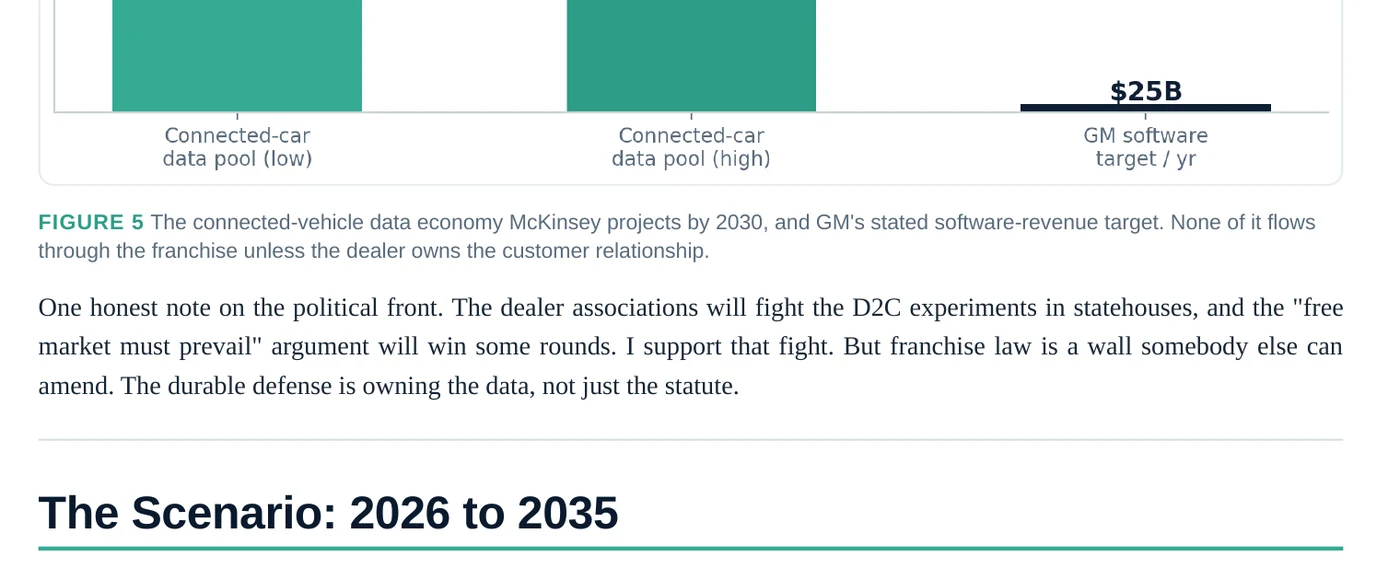
McKinsey projects the connected-vehicle data economy at $250 to $400 billion by 2030. GM has publicly targeted $20 to $25 billion in annual software and services revenue by the same year. None of that flows through the franchise channel unless the dealer owns the customer relationship end to end. The intelligence layer is the toll booth. Own the toll booth, or watch the traffic move to a road that doesn't have one.
One honest note on the political front. The dealer associations will fight the D2C experiments in statehouses. I support that fight. But franchise law is a wall somebody else can amend. The durable defense is owning the data, not just the statute.
The scenario: 2026 to 2035
Elena Carver's January 2026 problem looks like a phone problem. Her BDC is four people budgeted for six. Her mystery shop says the store's median response to an internet lead is 41 minutes. Then in February her twenty-something ops manager, Dev, shows her the study of 100 dealerships. Dev asks the question that reroutes the store's decade: "Which bucket were we in?"
They mystery-shop themselves that week. Carver is in the 67. The store answered, eventually, with a template. The agent graded it and moved on, and no human at Carver ever knew the opportunity existed.
Only 33 of 100 dealerships gave the AI shopping agent a full out-the-door price. Carver was in the 67.
“Every AI failure is a data failure wearing an AI costume.”
Roughly 40 percent of DMS customers no longer own the vehicle on their record. Contact data decays at about 25 percent a year. On a typical repair order the store writes about $900 in recommended work and collects about $494. A multiplier on garbage is faster garbage. An agent texting a dead number at 9 p.m. is not automation. It is your dirty database with a personality.
Elena faces a fork nobody faced in the internet era: she cannot choose between the boring data work and the agents. She does both at once. Below is the ten-year run, with three operators sharing the same market. Switch paths. Same decade, three foundations.
Two tracks at once
Elena runs foundation and first defensive agents in parallel, not in sequence, because the calendar no longer allows doing them in sequence.
Track one: the foundation, compressed. Dev, who lived through the CDK outage at his last store, inventories every system that touches customer or transaction data. Fourteen systems. Then he reads the contracts, and the room gets quiet. Several vendors have rights to Carver's transactional data, the check-writing moment, the most coveted data in retail. At least two are free to refine it into benchmarks sold to other stores, including Meridian Chevrolet down Route 23.
Carver stands up an owned intelligence layer. The layer pulls DMS, CRM, website, and service data into one place Elena contractually owns, then does the two jobs no dealer system has ever done well. Identity resolution collapses "Robert Sandoval," "Bob Sandoval," and "R. Sandoval Trucking" into one household with one history. Hygiene retires the dead numbers and the workarounds. The first honest census is humbling: 31,000 DMS "customers" resolve to about 19,400 real households, of which about 11,000 plausibly still own the vehicle on file. A dealership context file, one living document that tells any AI system what Carver is, gets written in two afternoons. It costs nothing but candor.
Track two: the first defensive agents, fast. After-hours lead response goes live in May, not next year. The agent answers every internet lead in about two minutes, around the clock, running against the cleanest slice of the layer first. By fall, the store can produce a full out-the-door number, taxes and fees itemized, in one exchange, from owned data, with a human approving the template. When a shopping agent asks, Carver answers completely. Two pilots run behind the rep: an internal assistant that drafts multi-point inspection findings into plain-English upsell language, and an SOP drafter that turns the used car manager's tribal knowledge into written process.
“AI behind the rep, not in front of the customer. The customer talks to a person. The person talks to a system that knows everything.”
By the fourth quarter the combined tracks are already paying. Identity resolution surfaces 640 households in positive equity with a service appointment in the next 90 days; the desk works them, and used acquisition gets cheaper. Declined-service follow-up attacks the ugliest number in fixed ops: the store writes about $900 in recommended work and collects about $494. That gap was never a selling problem. It's a memory problem, and now the store has a memory. Two agent failures cost the store five figures each: one quoted a trim mismatch, one misfired on a service reminder. Elena publishes both incidents internally and adds them to the governance rulebook.
- Intelligence layer maturity
- Pillars 1-3 live
- Front-line headcount
- 64 → 62
- Median lead response time
- 41 min → ~2 min, 24/7
- Full OTD quote capability
- No → Yes
- Records resolved to real households
- 0% → 100%
- F&I gross PVR
- $2,505 → $2,525
- Net margin
- 2.2% → 2.4%
- CSI (100 = top box)
- 78 → 80
- AI agents deployed
- 0 → 4 (2 internal, 2 perimeter)
Industry median: response 24 min; net margin 2.1%; can answer a shopping agent with a full OTD quote: roughly 1 store in 3.
Table stakes, proliferation, and the first blowups
What was an edge in 2026 is an expectation by 2027. Customer-side agents proliferate. The big consumer platforms ship shopping assistants as default features, not downloads. By summer, a meaningful share of Carver's inbound "leads" are agents: structured, relentless, allergic to templates. Stores that cannot answer a shopping agent with accurate, instant, owned-data responses lose the deal before a human at the store ever knows there was a deal.
Carver's machine wins those exchanges because of what it answers with. The agent reads from the intelligence layer. It knows this shopper is a service customer of nine years with a trade in equity, and it says so, correctly, at 11:40 p.m. The agent stack deepens all year. Service scheduling books against the shop's real capacity, and no-shows drop by a third. A defection model flags households drifting to the independent shop down the street. Hourly used-car repricing drafts price moves with a human approving every change.
One 2027 move matters more than any deployment. Elena gives Dev a title, Dealership AI Builder, four protected hours a week, and a problem list. This is the hire I tell every dealer to make, and the joke is that it is usually not a hire. It is the under-30 already in your building who automated something without being asked. Within a quarter, Dev kills a $50,000-a-year vendor contract by rebuilding the function in-house on the layer for about $5,000.
2027 is the year the industry gets its first agent-era scandals. A group in the Southeast gets caught with a home-grown F&I bot quoting back-end products in patterns that correlate with zip codes: a fair-lending nightmare built out of good intentions and bad training data. An import store's unsupervised sales agent promises out-the-door numbers it has no authority to honor, and a state AG collects screenshots. Every one gets reported as an AI failure. Look closer. Bad training data, no authority model, no audit trail. Data failures, every one of them, wearing the costume. Carvana closes on Stellantis franchise points and runs its used-vehicle playbook on new inventory. The forums call it an outrage. Elena calls it a preview.
- Intelligence layer maturity
- All five pillars live
- Front-line headcount
- 62 → 57
- Median lead response time
- ~2 min → <30 sec, 24/7
- Inbound leads that are agents
- ~4% → ~18%
- F&I gross PVR
- $2,525 → $2,570
- Total gross per unit retailed
- $4,480 → $4,530
- Net margin
- 2.4% → 2.8%
- CSI
- 80 → 84
- AI agents deployed
- 4 → 9
Industry median: response 8 min; net margin 2.0%; full OTD quote to a shopping agent still a minority.
The shakeout starts early, and Marcus Chen's best hour
I used to put the foreclosure year at 2031. I was wrong by three years, and the reason is the counterparty. When the customer's agent compares every store in the market instantly and permanently, weak stores lose the polite cushion of customer inertia. The band that held for fifty years breaks in 2028 for the laggards. Fast response is no longer a differentiator; it is a cost of entry. Carver's total gross per unit falls this year. Elena expected it, because the core prediction of this scenario is that the advantage migrates from the revenue line to the cost, retention, and trust lines. Her SG&A per unit is down 19 percent from 2025. Personnel expense is down more, while pay per remaining employee is up 14 percent.
A meaningful slice of the dealer body posts losing quarters in 2028, in a flat market, for the first time in the fifty years Mercer measured. Buy-sell activity jumps. The OEMs formalize costume four. Burned by the 2027 blowups, they roll out certification for AI-touched processes: approved disclosure language, required human sign-off points, audit-log standards. Carver certifies in one cycle because the audit spine already exists. Stores on black-box point solutions discover their vendors cannot produce the logs, and pay for a forced re-platforming at the worst possible time.
- Intelligence layer maturity
- OEM-certified, first cycle
- Front-line headcount
- 57 → 52
- Median lead response time
- <30 sec → instant, all channels
- Inbound leads that are agents
- ~18% → ~35%
- F&I gross PVR
- $2,570 → $2,620
- Total gross per unit retailed
- $4,530 → $4,450 (compression begins)
- Net margin
- 2.8% → 3.1% (crosses 3% early)
- CSI
- 84 → 87
- AI agents deployed
- 9 → 12
Industry: median net 1.9%; bottom quartile posts losing quarters; the 50-year band is broken for the laggards.
The Nucleus becomes the norm, and the OEM finishes changing
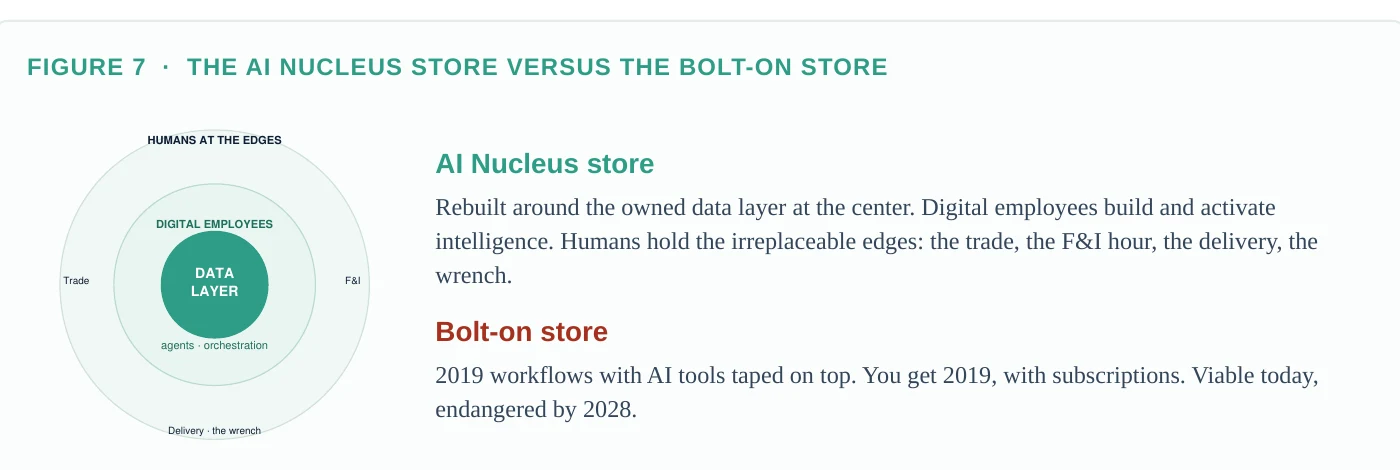
By 2029, among the survivors, the redesigned store stops being a case study and becomes the norm. The bolt-on store took 2019 workflows and taped AI tools to them, and got 2019 with subscriptions. The Nucleus store is rebuilt around the intelligence layer at the center: data infrastructure and digital employees in the middle, humans deployed at the irreplaceable edges. The trade negotiation. The delivery. The complaint. The wrench.
Customer-side agents are now simply how a large share of the market shops. Stores that outsourced their AI to marketplaces discover what they became: anonymous fulfillment nodes, inventory endpoints in someone else's app, competing on nothing but price. Lenders move too. Captives and banks fund certified, machine-verified deal jackets faster and with fewer stips. The OEM's shift completes. All five costumes are on stage at once. The middle hollows. The dealer body sorts into thirds: intelligence owners trending toward 3.5 percent net and above, renters paying rising tolls near the old median, holdouts running a 2019 cost structure into the floor.
Elena becomes a consolidator in 2029, acquiring a struggling Lincoln point two towns over. The integration takes eleven weeks instead of eighteen months, because integrating a store now means pointing its data at your intelligence layer and retraining forty humans instead of rehiring a hundred. The reviews stop mentioning speed and start saying the sentence Elena reads twice: "They actually knew me."
- Intelligence layer maturity
- Nucleus; one layer, two stores
- Front-line headcount per rooftop
- 52 → 47
- Inbound leads that are agents
- ~35% → ~55%
- F&I gross PVR
- $2,620 → $2,660
- Total gross per unit retailed
- $4,450 → $4,340
- Net margin
- 3.1% → 3.6%
- CSI
- 87 → 90
- AI agents deployed (per store)
- 12 → 14
Industry: rooftops ~16,300 and declining; median net 1.7%; owner third ~3.5%.
The gap goes categorical
These are the years the race stops being a race, because the distance stops being closable. An intelligence layer compounds. Every conversation, every RO, every deal adds to a memory that makes the next interaction smarter. A store that started in 2026 has seven years of compounding by 2033. A store starting in 2031 is not four years behind; it is four years behind a moving target. Fixed ops is the crown jewel. With the car parc aging and vehicles more software-defined, service is where durable margin lives. Absorption sits at 74 percent. The connected-car service leads the OEM routes to certified stores flow disproportionately to Carver, because Carver's layer closes them and proves it.
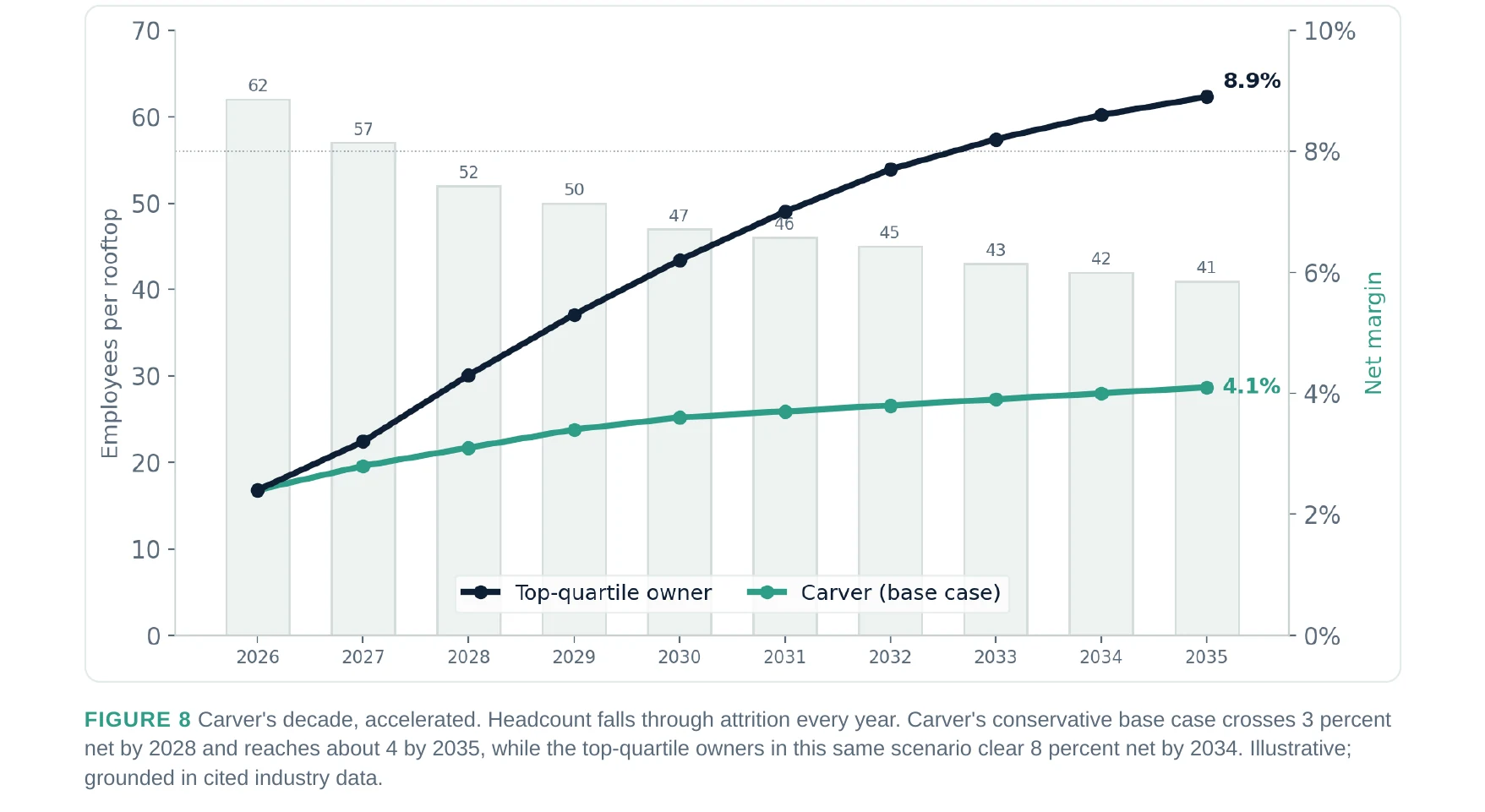
The org chart finishes at about 43 people per rooftop. Zero "BDC reps." The settled new roles: agent supervisor, product specialist, delivery concierge, data steward, and one Dealership AI Builder per group. Technicians, the one job the machines made scarcer and more valuable, finally earn what electricians earn. Payroll is 12 percent below 2025. Average comp per person is 31 percent above it. Turnover sits near 30 percent, luxury-store territory. Elena adds a third rooftop in 2032.
- Intelligence layer maturity
- Nucleus standard; 7 years of memory
- Front-line headcount per rooftop
- 47 → 43
- Inbound leads that are agents
- ~55% → ~70%
- F&I gross PVR
- $2,660 → $2,700
- Total gross per unit retailed
- $4,340 → $4,180
- Net margin
- 3.6% → 3.9%
- CSI
- 90 → 91
- Fixed ops absorption
- 74%
Industry: rooftops ~15,900; owner third margin ~3.6%; median 1.5%. The gap is now categorical.
The intelligence-owned dealership
Three rooftops. Front-line headcount per rooftop of about 41, down from 43. Roughly 75 percent of inbound leads originate from agents, not humans. F&I gross PVR at $2,700, holding. Total gross per unit retailed at about $4,100. Net margin at 4.1 percent. CSI at 92. The industry has roughly 15,400 rooftops, down from 16,990, and the owner third of that population sets the benchmarks. The separation dates to 2028 and 2029, not to 2035.
- Rooftops
- 3
- Front-line headcount per rooftop
- ~41 (from 64)
- Inbound leads originating from AI agents
- ~75%
- F&I gross PVR
- $2,700
- Total gross per unit retailed
- ~$4,100
- Net margin
- 4.1%
- CSI
- 92
- US franchised rooftops (industry)
- ~15,400 (from 16,990)
- Blue-sky enterprise value vs. 2026
- ~2.0x
Illustrative composite; grounded in NADA, Presidio-NCM, and Haig Partners benchmarks. The separation dates to 2028 and 2029, not to 2035.
Base case vs top quartile: the levers, honestly
Two dealers, same market, both running an intelligence layer. Why do their 2035 numbers diverge? Six levers, not one. Data hygiene: the top quartile treats identity resolution as a permanent job, not a one-time cleanse. Agent depth: how much of the funnel the agents actually own vs. how much the store defends with humans out of habit. Governance discipline: audit logs read weekly, not annually. Acquisition cadence: the layer is only a lever if it digests new rooftops. OEM posture: partner or fulfillment node, and you decide which by 2029. Human bench: fewer people, higher-context, better paid. Most of the margin gap between the base case and the top quartile lives in the last two.
The honest ledger
What Elena gained: margin durability, acquisition capacity, staff that stays, customers that return at rates the industry used to call impossible, an enterprise worth roughly double on the blue-sky line, an OEM that treats her as a partner because she holds an asset it needs, and Saturdays.
What it cost: a brutal 2026 running two tracks at once. Real money in 2026 to 2028 before full payback. Two agent failures that cost five figures each. Hard conversations as roles sunset through attrition. The permanent discipline of auditing machines the way she used to audit people.
What she got lucky on: the OEM certification regime could have been hostile to dealer-owned layers and wasn't. The soft patch could have come in 2027, before her cost structure turned over. A fair scenario admits its protagonist drew some decent cards.
“The dealers who won the decade did not predict the future better. They owned the one asset the future runs on, and they started before the customer's agent finished grading them.”
The four paths, played forward
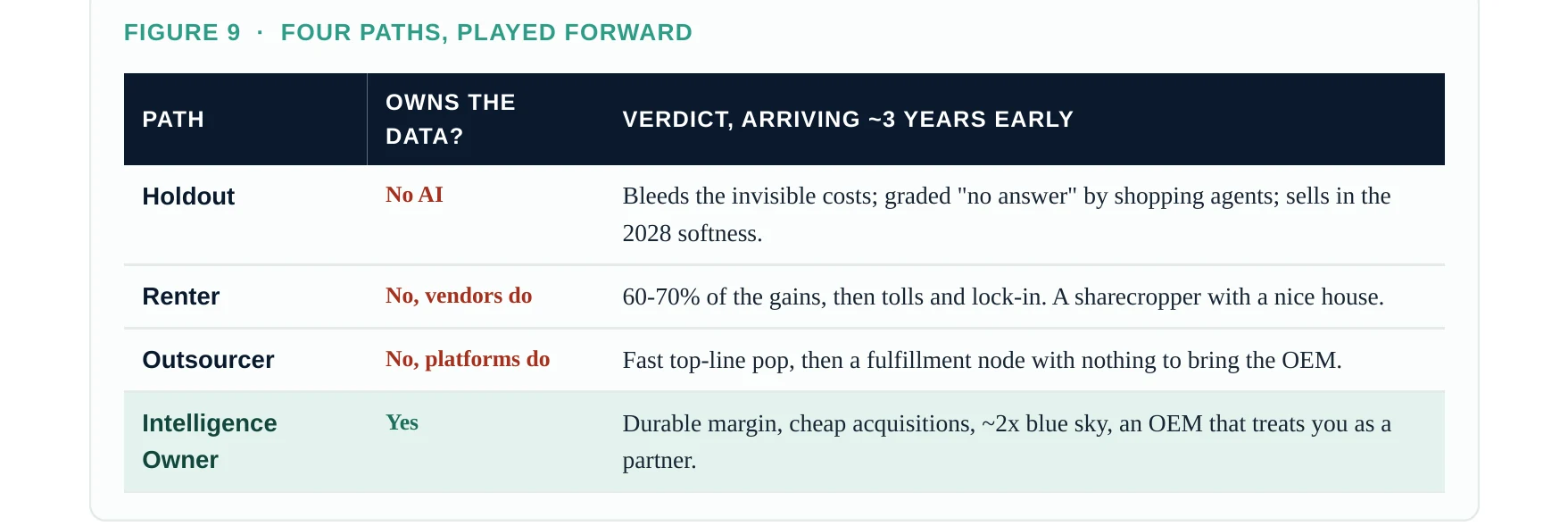
The scenario follows one strategy. Here are the four a dealer can actually choose, played forward honestly. Same world, different choices. In the accelerated decade, every verdict arrives about three years earlier than the internet era would have delivered it.
Path 1: The Holdout
"We sell cars with people. Always have." Through 2026 the Holdout loses only what he cannot see: the 9 p.m. leads, the shopping agents that graded his store "no answer" and never came back. By 2028 the invisible is a P&L line. Fully loaded cost per sale runs $900 above the owner across town, and on 2 percent net that is the margin, not a rounding error. By 2030 the Holdout is either sold, or the sole ownership of a franchise that trades at a discount because buy-sell advisors now line-item "data and intelligence infrastructure" in their models.
Honest credit: the Holdout is right that trust and craft still close deals. He is wrong that craft alone answers a shopping agent at 11 p.m. on a Sunday.
Path 2: The Renter
"Best-of-breed from our vendors." The Renter gets maybe 60 to 70 percent of the operational gains through 2027. Then the three bills arrive: fragmentation, tolls, and the exit clause. Four point solutions each running on their own sliver of his data. Renewal pricing "adjusts" 30 to 50 percent upward once every workflow depends on them. The exit clause reveals that conversation history and derived insights are the platform's work product, not his. The Renter's vendors sit on his transactional data, refine it into intelligence, and sell it back to him by the month. He is a sharecropper with a nice house.
Honest credit: renting gets you to a demo in 30 days. Owning takes six months and looks less exciting the whole time. The Renter's discount is real. It is also a balloon note.
Path 3: The Outsourcer
"Get our inventory everywhere; let the platforms bring buyers." The fastest top-line pop of any path, followed by the oldest story in retail. The platform's take-rate grows until it consumes the marginal player's margin. The relationship belongs to the app. The retailer becomes interchangeable by design. Ask a hotel operator about OTAs, or a restaurant about delivery apps, and price the outcome forward five years.
Honest credit: the Outsourcer moves inventory the Holdout cannot reach. He also trains a generation of customers to think of the brand, not the store.
Path 4: The Intelligence Owner
"My grandfather owned the land. My father owned the building. I own the data and the intelligence layer."
More expensive up front than renting, less exciting than outsourcing, harder than holding out. The payoff is structural: costs that scale down, intelligence that compounds in an asset you own, compliance you can prove, acquisitions you can digest, a first-party answer for every shopping agent, an OEM conversation you enter holding cards. This is the path Carver ran, and the only one where the last page of the ten-year story reads as an opportunity instead of an autopsy.
Honest credit: this path is the longest to prove out. It also is the only one that appreciates every year instead of depreciating.
“Own your intelligence. Do not rent it. Everything else in this paper is footnotes to that sentence.”
The AI Nucleus and the five pillars
Everything in this paper assembles into one structure. I call it the AI Nucleus. Not a tech stack you buy, but a redesign of the store around four layers, built from the bottom up. The order is the strategy: clean owned data first, then documented workflows, then the AI and its intelligence loops, then the digital employees that run the whole thing.
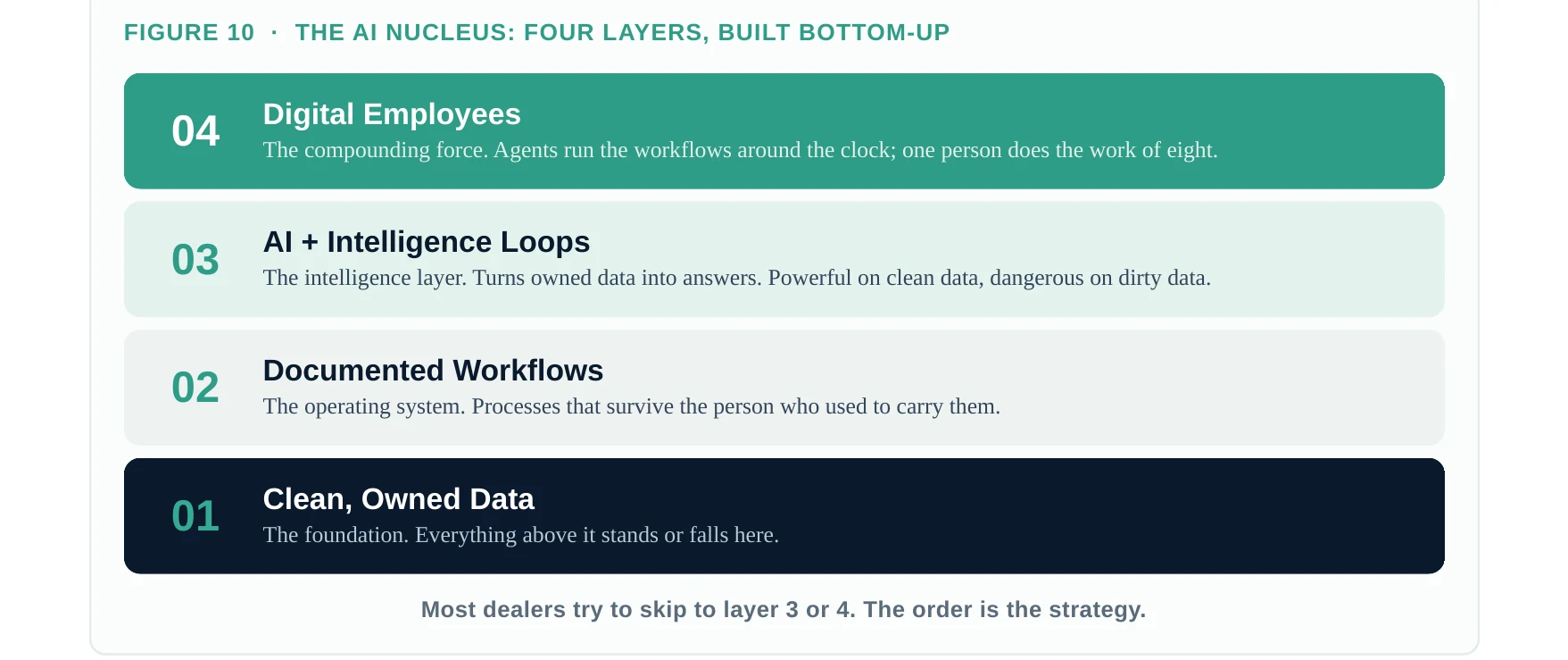
- Layer 1 · Clean, owned data. The foundation. Extracted out of the fourteen systems into a repository the dealer contractually owns, because everything above it stands or falls here.
- Layer 2 · Documented workflows. The operating system. Real processes written down, role-assigned, and teachable on day one, so the store survives the person who used to carry it in his head. In this scenario that is the dealership context file and the SOPs the agents actually run.
- Layer 3 · AI and intelligence loops. The layer that turns owned data into answers and actions. Powerful on clean data. Dangerous on dirty data.
- Layer 4 · Digital employees. The compounding force: agents that run the documented workflows against the intelligence layer around the clock, where one person managing a fleet of them does the work of eight.
Skip a layer and everything above it wobbles, which is exactly what a dealer is doing when he buys a chatbot before he owns his data. The intelligence layer this paper keeps circling back to is layers one and three. The AI Nucleus is the whole building, and it only stands if you pour the foundation before you frame the roof.
Layers one and three break down further into five pillars, and this is where most of the hard, unglamorous engineering lives. They are the architecture of QoreCloud, so read the list as both framework and disclosure.
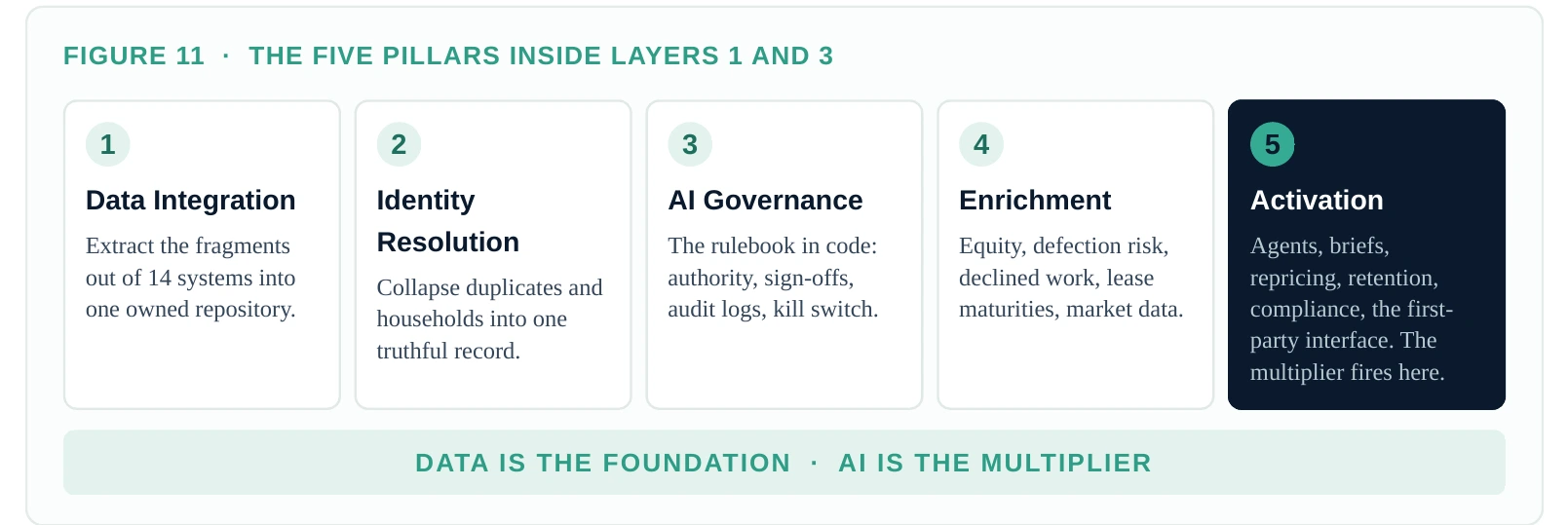
- 1. Data Integration. Get the data out of the fourteen systems and into one owned repository: DMS, CRM, website, service, phones, marketing. Not a nightly copy into another vendor's silo. An extraction into a layer the dealer contractually owns, portable and exportable. The hardest and least glamorous pillar. Everything else stands on it.
- 2. Identity Resolution. Collapse duplicates, households, cosigners, and businesses into one truthful record per relationship. Where 31,000 records become 19,400 households, and 40 percent of your "customers" get correctly re-labeled as previous owners instead of robocalled about a truck they sold.
- 3. AI Governance. The rulebook in code. What any AI may say, decide, and touch. Where humans must sign. Immutable audit logs of every action, retained in the dealer's custody, surviving any vendor termination. A kill switch. Governance is a pillar, not a policy binder. Valley Motors had the binder.
- 4. Enrichment. The unified record made smarter: equity positions, defection risk, declined-work history, lease maturities, household events, market data. Enrichment is the refining step, the difference between having data and having intelligence. It is also exactly the step your vendors have been performing on your data for their benefit.
- 5. Activation. The layer put to work: agents, campaigns, desk briefs, repricing drafts, retention plays, compliance checks, and the first-party interface that answers the customer's shopping agent. Notice it's pillar five, not pillar one. Every failed AI rollout I have autopsied started at pillar five.
One note the accelerated decade forces. You no longer get to build pillars one through four in peace and then activate. The shopping agents are already at the door. So a narrow slice of pillar five, after-hours response and accurate quoting, goes live early, on the cleanest data you have, with governance already in place. The pillars are still the sequence of investment. They are no longer a sequence of years.
Evaluate any vendor, mine included, against these five. Ask which pillars they actually build, and who owns the output of each.
The Nucleus store vs. the bolt-on store
Most dealers who "adopted AI" in 2025 and 2026 did the bolt-on: took 2019 workflows and taped agent tools to them. It looked like progress on the demo. It felt like paying more for the same store on the P&L. The Nucleus rebuilds the store around the owned data layer at the center, with humans at the irreplaceable edges. Same tools. Different building.
Data ownership, F&I, org design, and the blue-sky math
B · The data-ownership lesson: CDK, Tekion, and the box you do not own
Three facts from 2024 and 2025 belong laminated in every dealer principal's desk drawer.
- June 18, 2024: the BlackSuit ransomware group breached CDK Global, the DMS serving roughly half of America's dealers. About 15,000 rooftops lost core operations for two to three weeks. A ransom reportedly near $25 million was paid. Analysts estimated more than 60,000 new-vehicle sales lost in June alone. Stores wrote deals on paper, when they could reach their own customer records at all.
- Tekion v. CDK: a rival DMS sued CDK alleging it blocked dealers from moving their own data to competing systems, holding it hostage in the complaint's framing, with access restrictions and punitive integration fees as switching-cost weapons.
- February 2025: court approval of CDK's $100 million settlement over alleged coordination with Reynolds & Reynolds, the two vendors who between them dominate the DMS market.
The synthesis: concentration plus captivity equals fragility plus rent extraction. Dealers did not choose this. It accreted over decades while data looked like plumbing.
Now raise the stakes. A DMS holds your records. An intelligence layer holds your relationships: every conversation, preference, objection, and behavioral signal. That compounding knowledge increasingly is the goodwill on your balance sheet. Locked-in records were a three-week catastrophe. Locked-in relationship intelligence is a permanent one, because records can be rebuilt and ten years of memory cannot.
The 2024 outage was never really about ransomware. It was about dependency. The AI era offers a thousand new ways to repeat that dependency at ten times the stakes, and one way to avoid it, which is the subject of this paper.
C · F&I and compliance-enforcing AI
F&I is the profit engine and the store's greatest regulatory exposure at the same time. It ran around $2,505 per vehicle in early 2025, near historic highs, and for many stores it is the difference between profit and loss. The transformation runs in three phases, and in the accelerated decade the phases overlap.
Phase 1, the checker (2026 to 2027). AI verifies rather than sells: deal-jacket completeness, disclosure timing and sequence, OFAC and red flags, menu consistency, chargeback-pattern detection. The standard is binary: if the AI cannot prove the step happened, the step did not happen. Pure upside, no new risk surface. Start here. Carver did, in year one.
Phase 2, the preparer (2027 to 2029). The layer assembles the deal before the customer sits: lender-ready files, consistently structured menus, product education at the customer's pace. The human handles the trust hour, the Marcus Chen hour. Deals per manager rise, and PVR holds because the value presentation improves even as pace does.
Phase 3, the negotiated frontier (2029 and beyond). Customer-side agents request terms machine to machine. Lenders certify verified pipelines. Regulators require conversation-level records. The stores that thrive here are the ones whose Phase 1 discipline gave them years of clean audit spine.
Non-negotiables, learned at Valley's expense: never give a selling agent pricing or approval authority without human sign-off. Never deploy a customer-facing interaction you cannot replay verbatim years later. Test proactively for disparate outcomes. Treat opt-outs as sacred.
D · Org design: what happens to the 64-person rooftop
The average rooftop employs about 64 people and replaces 42 percent of them annually, including 73 percent of sales consultants at non-luxury stores and 60 to 100 percent of BDC staff at $15,000 to $30,000 per replacement. The pre-AI dealership was never a stable employer that technology disrupted. It was a perpetual churn machine burning money and people in roughly equal measure.
The trajectory in this scenario: about 64 in early 2026, 52 in 2028, 47 in 2030, 41 in 2035, essentially all through managed attrition. No scenario year requires a layoff at Carver. Every year requires the discipline of not backfilling and the honesty of telling the team which roles are sunsetting.
What shrinks: the BDC as a department (reborn smaller as agent supervision), the entry-level burnout tier of sales, clerical deal processing, the phone-and-paperwork share of service advising.
What grows or upgrades: agent supervisors doing QA, escalation, and coaching the machines. Product specialists. Delivery and owner-experience roles. Data stewards. And technicians, whose scarcity premium rises because the machines diagnose and schedule but do not turn wrenches.
The hire that matters most: the Dealership AI Builder. Usually already in your building: the under-30 who automated something without being asked. Give that person a title, four protected hours a week, and a problem list. The Builder configures agents against your context file, tunes what drifts, and tells you when a $50,000 vendor contract is a $5,000 in-house problem.
The comp change worth advertising: fewer seats, materially higher pay per seat, turnover falling toward luxury levels. By 2033 Carver recruits from stores that out-pay it on plan, because "the machine does your paperwork" turns out to be the best comp plan in retail.
E · Unit economics and the blue-sky math
All figures for a deliberately ordinary rooftop: about 115 new plus 95 used a month, roughly $4,400 total gross per unit, 2.2 percent net. Year-one costs, honestly: intelligence layer plus first agents at $4,500 to $9,000 a month; extraction, integration, identity resolution and cleanup at $25,000 to $60,000 one time (dirty data is the usual overrun); plus a real project owner at roughly quarter-time for six months.
Year-one returns: BDC restructuring saves $150,000 to $200,000, plus $40,000 to $120,000 a year of recurring turnover waste eliminated. Recovered leads add 8 to 14 incremental units a month, roughly $420,000 to $740,000 in annual gross. Fixed ops capture: 2 to 4 points of absorption, $100,000 to $250,000 a year. Cash payback in 4 to 9 months in most defensible constructions. On a 2 percent store, a dollar of cost removed is worth roughly fifty dollars of revenue added.
Then the enterprise math dwarfs the operating math. Buy-sell firms like Haig Partners price blue sky at roughly five times adjusted net. Move a store from $2.5 million to $5 million of net, the trajectory this scenario describes, and blue sky moves from about $12.5 million to $25 million. A five-store group doing the same moves from roughly $62.5 million to $125 million. No facility upgrade, no point acquisition, no OEM program has ever offered a dealer that lever. The intelligence layer does not belong in the software budget. It is a valuation event. And in the accelerated decade the buy-sell market starts pricing it by 2028, not 2031.
The 90-day operating plan
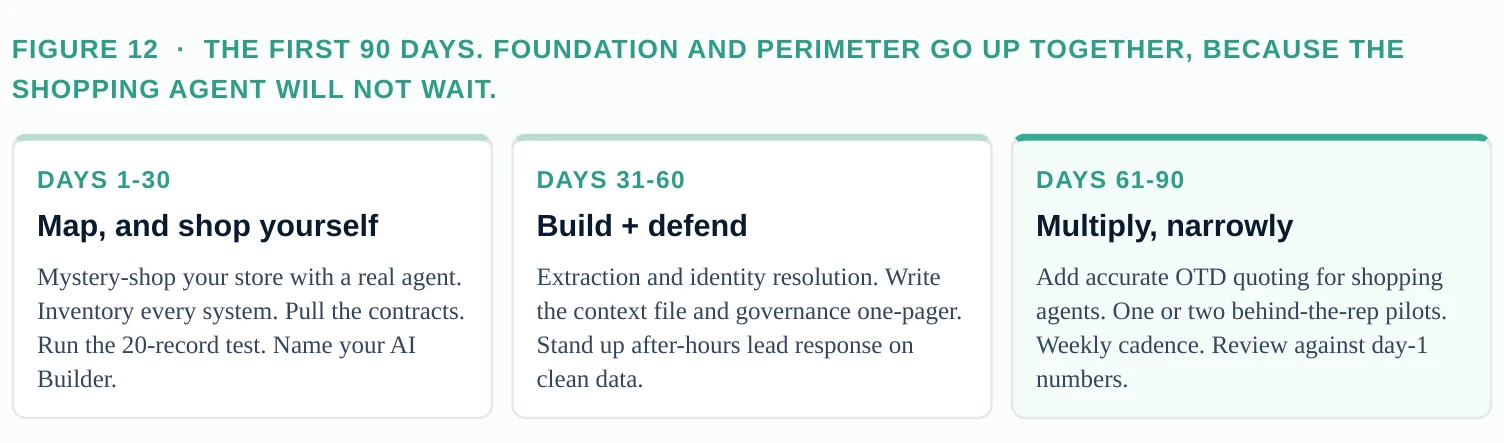
Strategy without a Monday morning is a slogan. Here is the first 90 days, sized for a single rooftop. An earlier version of this plan kept customer-facing AI out of the first quarter entirely. The 100-store study changed that. The perimeter now goes up in parallel with the foundation, narrowly and with the lights on.
Days 1 to 30: map the ground, and shop yourself
- Mystery-shop your own store with a commercial shopping agent. Find out today whether you are in the 33 or the 67, before a customer's agent finds out for keeps.
- Inventory every system holding customer or transaction data. Expect a dozen or more.
- Pull the contracts. For each one: who owns the data, who owns derived insights, what exports exist, what exit costs. Highlight every clause that would embarrass you read aloud at a 20 Group.
- Run the twenty-record test in front of your managers. Count dead numbers, duplicates, and none@gmail.com. Let the room feel it.
- Name your Dealership AI Builder. Title, four protected hours a week, first problem.
Days 31 to 60: build the substrate, open the perimeter
- Begin extraction into an owned intelligence layer: pillars one and two, integration and identity resolution. Get a truthful household count and a truthful ownership count.
- Write the dealership context file with your managers: pricing rules, authority limits, policies, the fifty real questions, the ten forbidden answers. Two afternoons and a pizza budget.
- Draft the governance one-pager: what AI may touch, where humans sign, audit trail on every action, and a kill switch anyone on leadership can pull without a vendor ticket.
- Stand up after-hours lead response on the cleanest data slice, under the governance one-pager, with a human reviewing transcripts daily for the first month.
Days 61 to 90: multiply, narrowly
- Add the quoting capability: a full, accurate, itemized out-the-door answer, template approved by the desk, every number sourced from owned data. When a shopping agent asks, answer completely. Most of your market still will not.
- Launch one or two behind-the-rep pilots: service scheduling with no-show follow-up, declined-service recovery, or MPI upsell drafting. They pay fastest and risk least.
- Stand up the weekly operating cadence: thirty minutes, same day, every week. Transcript spot-checks, escalation review, one metric per pilot, one thing to kill or fix.
- At day 90, review against numbers you wrote down at day 1. Then decide what to scale.
The window for this work is 12 to 18 months, and shrinking, and the clock does not start when you feel ready. It started when a shopping agent queried 100 stores and only 33 could answer.
Five questions to bring to any AI vendor
Print these. Bring them to every demo. Any flinch is your answer. Score any vendor, mine included.
- 01How does your product work on data that has not been cleaned?
If the answer is "it just works," the vendor has never met a real DMS. The honest answer describes integration and identity resolution, or admits it depends on someone else doing them.
- 02How does it enforce my compliance steps?
Not "supports." Enforces. Where are the hard gates, where does a human sign, and can I replay any interaction verbatim years later? If the AI cannot prove the step happened, the step did not happen.
- 03How does it handle a model change?
Models will be swapped under every product you buy this decade. What breaks, what gets retested, and who tells you? A vendor without a model-change process is a vendor you are beta testing for.
- 04What does it look like behind a human rep instead of in front of the customer?
If the only demo is a bot talking to your customers, the vendor is optimizing for their sizzle reel, not your CSI. The exception is the machine-to-machine perimeter, and even there, see the guardrails before the demo.
- 05What do I own if I leave?
Data, conversation logs, derived insights, audit trails: full fidelity, documented formats, no penalty, exercisable any day. Any vendor who cannot answer this cleanly, including QoreAI, deserves to lose the deal.
A Saturday in the intelligence-owned store
Marion, Ohio, 2036. Elena Carver gets to the store at nine now, not seven. The overnight brief is waiting, written by her own layer, not assembled by a person at 6 a.m. Fourteen appointments, each with the customer's whole story attached. Two escalations flagged for humans: a widow transferring a title and a fleet buyer with a custom ask, exactly the two conversations that should find a person. She reads it with her coffee, standing where the BDC cubicles used to be. It is a customer lounge now.
The people who remain are the point. Marcus Chen, twelve years in the box, a lifer in a job that used to break people, spends his morning on two trust conversations and a delivery. No paperwork. He will out-earn the store's old GSM this year. Priya, once the BDC's last hire, supervises the agent fleet across three rooftops and tells her kids her job is "teaching the store to be polite." Dev runs the Builder bench for the group and killed two more vendor contracts this quarter. The service drive hums at 76 percent absorption. Nobody stands at a counter repeating a phone number.
At 11 a.m. a shopping agent belonging to a customer in Columbus queries the store about a used Explorer. It asks forty-one questions in nine seconds. Carver's layer answers every one, truthfully, from a decade of owned history, and books the test drive for 2 p.m. Ten years ago, when an agent like this one shopped 100 stores, only 33 could give it a straight answer. Carver has been in the 33 since the first year.
The factory calls Elena a partner now, and means it, because she holds the one thing its telematics cannot see: the trust of eleven thousand households, documented. What Elena got back is hard to put on a statement. The store no longer runs on her adrenaline. It runs on a system she owns: the data, the intelligence, the logs, the memory. An asset she can hand to her daughter the way her father handed her a building and a sign.
Thirty-six years, and why this one is different
I have spent thirty-six years in this business, from the floor of a dealership to the technology that runs them. I sold my first car in 1990, in a store with no computer on the desk and no internet in the building, when the dealer held every number and the customer held none.
I have watched crisis after crisis since. The internet took the information edge we had sold for a century. The 2008 meltdown put two of the Big Three into bankruptcy. The pandemic and chip shortage turned the inventory model upside down. In 2024, a single vendor outage put roughly fifteen thousand stores back to writing deals on paper for three weeks. Every one of those felt, in the moment, like the end of the business. It never was.
This one is different. AI does not arrive like a storm. It compounds. The work a model can do on its own has been doubling on a clock, not creeping, and a curve that doubles looks flat right up until it goes vertical.
Thirty-six years taught me one thing worth a whitepaper: the store you hand to your kids is the one you own from your data all the way down to the dirt.
“Data is the foundation. AI is the multiplier. The dealers who confuse the two will spend the next decade renting their own future back, one month at a time.”
Questions about Auto Retail 2035
What is the AI Nucleus dealership?
+
The AI Nucleus is the architecture at the center of the Intelligence Layer dealership. It is a governed, dealer-owned context layer that unifies CRM, DMS, inventory, service, and customer signals so autonomous agents can act on behalf of the store without leaking data to vendors. It rests on five pillars: data ownership, context, governance, agent orchestration, and human escalation.
What is the Intelligence Layer in auto retail?
+
The Intelligence Layer is the software tier that sits between the OEM, the dealer, and the customer's AI shopping agent from 2026 through 2035. Dealers who own their Intelligence Layer keep pricing power and customer relationships. Dealers who rent it from vendors or OEMs give up both, permanently.
What are the four operator paths in Auto Retail 2035?
+
Absorb: do nothing, get consolidated. Adopt: buy vendor AI and rent the future one month at a time. Amplify: layer AI on top of owned data and workflows. Author: build the Intelligence Layer and become the operating system for your market. Only Amplify and Author preserve blue-sky value through 2035.
What is the shape-shifting OEM?
+
It is how manufacturers will oscillate between three archetypes from 2026 to 2035: OEM-as-Retailer (agency model), OEM-as-Platform (software and services revenue share), and OEM-as-Wholesaler (traditional franchise). Most OEMs will run all three simultaneously in different segments, which forces dealers to design for optionality rather than loyalty.
How will AI shopping agents change car buying?
+
By 2028, a material share of shoppers will delegate search, negotiation, and appointment-setting to a personal AI agent. Dealers who cannot accept agent traffic, machine-readable inventory, and API-based pricing will be filtered out before a human is ever involved. In an early 2026 test, only 33 of 100 dealerships gave a full out-the-door price to an agent inquiry.
What is the 90-day plan for dealership AI in 2026?
+
1) Name an Intelligence Layer owner and put data ownership language in every vendor contract. 2) Stand up a governed context file. 3) Run three pilots with hard exit criteria. 4) Publish an AI usage policy. 5) Instrument agent traffic and machine-readable inventory. The full checklist is inside Auto Retail 2035.
What is the 50-year profit band?
+
Franchised auto retail net margins have held between roughly 1 percent and 3 percent for fifty years, regardless of technology waves, recessions, or ownership consolidation. The Intelligence Layer is the first shift with the structural leverage to break the band in either direction.
Who wrote Auto Retail 2035?
+
Todd Smith wrote Auto Retail 2035: The Intelligence Layer, published July 2026. Todd is the CEO of QoreAI, the number one best-selling author of The Intelligent Dealership, and a 5x Inc. 500/5000 honoree with 30-plus years in automotive retail technology.
Download the full PDF, or bring this scenario to your team.
Todd delivers the Auto Retail 2035 scenario as a keynote for state dealer associations, OEM meetings, and 20 groups. The PDF is designed for boardroom print.