
Thirty-six years are being rewritten in plain sight
I’ve spent most of my working life in retail automotive. I’ve sold cars, run stores, and even owned a Chevrolet dealership. I was part of the team that brought this industry its first web-based CRM in 2000, and I built the first managed live chat solution for dealerships in 2007. I’ve watched three technology waves arrive, and been wrong about the timing of all three. I’ve never been wrong about the direction. Only about the speed.
These days I spend more time than is probably healthy testing what AI models can actually do. Not just reading about them. I’m using them, on real dealership problems, with real data. And what keeps pulling me back is the fact that the answer changes every few months, in the same direction.
Each time capability moves, another piece of the retail process becomes absorbable. First it was writing emails. Then answering the phone. Then deciding who to call and why. Then holding a conversation across a week without dropping the thread history. None of that was designed as a march through our business. It happened because most of what occurs in a dealership between a customer arriving and a customer leaving is information moving between people, and information work is exactly what these AI systems are created to understand and improve at a compounding rate.
Which means the parts of this business I was proudest of implementing are the exact parts of this industry that are the most exposed. I’m not saying that with alarm. I’m saying it because it’s true, and I would rather look at the effects directly than pretend the next decade will look like the last one.
Here is what actually worries me, and it’s not the technology.
This industry plans in model years and fiscal years. We, as industry leaders, think in straight lines, because a straight line has described this business accurately for over a century. AI capability is not arriving on that schedule. Linear planning against a curve feels completely fine right up until the moment it does not, and the gap never announces itself in advance. By the time it’s obvious in the numbers, the window to respond has already closed.
I am not going to predict a date. I do not know the date, and anyone who tells you they do is selling something. What I am confident about is this: the work that has to happen first is slow work. Owning your own operational record. Building a real memory of your store and your customers. Making your operations digitally accessible. Rewriting pay structures for your staff. None of that can be bought in a quarter, and none of it can be started the month you finally feel the pressure.
That is the whole reason for the urgency. Not because the technology is fast, but because the prerequisites are slow. The schedule is set by the slowest thing you have to do, not the fastest thing a vendor can demonstrate.
This paper is what I would tell a dealer over dinner if we had three hours and nobody was selling anything.
Start with the 8 a.m. meeting
Every morning in most stores, a group of managers walks into a room to tell each other what happened.
The used car manager knows which units have aged past sixty days. The service manager knows which techs are short on hours and which ROs are waiting on parts. The sales desk knows which deals died over the weekend and why. The parts manager knows what did not come in. For the next forty minutes, each person compresses what they know into a summary, hands it to the room, and takes back a set of priorities they will spend the day distributing to their people.
“That meeting is not a management practice. It is a data pipeline made of human beings.”
It exists because no single person can hold the entire state of the store in their head at once. Inventory position, recon status, tech capacity, parts availability, lender programs, deal pipeline, customer equity. So the store splits the data into departments, assigns a person to each, and rebuilds an approximate picture once a day by having those people talk.
Consider what that costs. The total picture is a day old before anyone acts on it. It is subjective, because each manager decides what is worth mentioning and what’s not. It’s political, because each manager is measured on the department they are summarizing. And it’s expensive, because the people doing the summarizing are the highest paid people in the building.
Now ask what we have actually done with AI so far.
The bolt-on era
Walk through any retail automotive store today and take a mental inventory of what dealers have bought in the last three years.
An AI that answers website chats. An AI that answers the phone after hours. An AI that writes vehicle descriptions. An AI that scores and prioritizes leads. An AI that mines the database for equity. An AI that drafts service upsell language. An AI that buys the ad inventory. An AI that summarizes the calls the other AI answered.
Every one of these is real. Several of them work. Most dealers can point to a number. Now look at the shape they all share, because the shape is the problem.
- Each AI tool attaches to a single department and sees only that department's slice.
- Each is fed by an export, a feed, or a screen scrape from a system that the dealer does not own.
- Each produces a list, a message, or a score.
- Each requires a person to act before anything happens.
- Each keeps what it learns, and takes that learning with it when a dealership cancels.
Here is the test. If you cancelled every AI product in your store tomorrow, what would your operation look like on Monday?
It would look exactly like it looked in 2019, just running a little slower. Not one process would be missing. Not one decision would be orphaned. Nothing structural would have to be rebuilt, because nothing structural was ever built by those AI tools.
“A bolt-on AI tool cannot outperform the process it is built upon. An AI that writes a better call list is still producing a call list.”
That’s the ceiling, and it’s a hard one. An AI tool inherits every constraint of the workflow it plugs into: the department boundary, the human handoff, the batch timing, the single system view. Making the list better forever still never changes what the list is or how long it takes to act on it.
Meanwhile the cost accumulates. Each bolt-on AI is another monthly line item, another vendor holding a slice of the customer relationship, another party enriching a dealer’s data on their servers rather than the store’s own. The stack grows and the operating model stays frozen.
None of this was a mistake. Bolt-on AI was the only thing available. But dealers cannot build something native on data they do not hold, using operations they cannot call. Every dealer who bought these tools was making a rational decision inside a real constraint.
What’s changed now is that the constraint is addressable. And the difference between a store that addresses it and a store that doesn’t is not going to look like a ten percent gap. It is going to look like two different businesses.
AI native does not mean more AI. It means the intelligence itself is not a tool the process uses. It is the foundation the process is built on.
The planning question changes. Stop asking where AI can be added to a workflow. Start asking what a workflow would even exist if the store’s memory were complete and every operation could be called by something other than a person at a keyboard.
This is an attempt to answer that question concretely, and lay out the order of operations required to get there.
Why we built it this way in the first place
Before designing something different, it is worth understanding why the current structure is so hard to move. It’s a structure much older than the DMS.
The Roman legion organized eight soldiers under a decanus, eighty under a centurion, and roughly five thousand into a legion. At each level a named commander gathered information from below and passed decisions down from above. That structure existed because of a limit that has not changed: one person can effectively direct somewhere between three and eight other people. We call it the span of control.
Military structure entered business through the American railroads, and the reason is worth sitting with, because it is the same reason you are reading this paper.
In 1855 the New York and Erie Railroad had a problem it never encountered before. The telegraph had just arrived. For the first time, information about what was happening five hundred miles down the track could reach headquarters almost immediately. The company was drowning in signal it had no way to act on, and nobody was clear who was responsible for turning any of it into a decision. Trains were colliding. Daniel McCallum, the general superintendent, worked with a civil engineer named George Holt Henshaw and answered the problem with a drawing.
It is generally considered the first modern org chart in American business. It’s also not what you would expect.
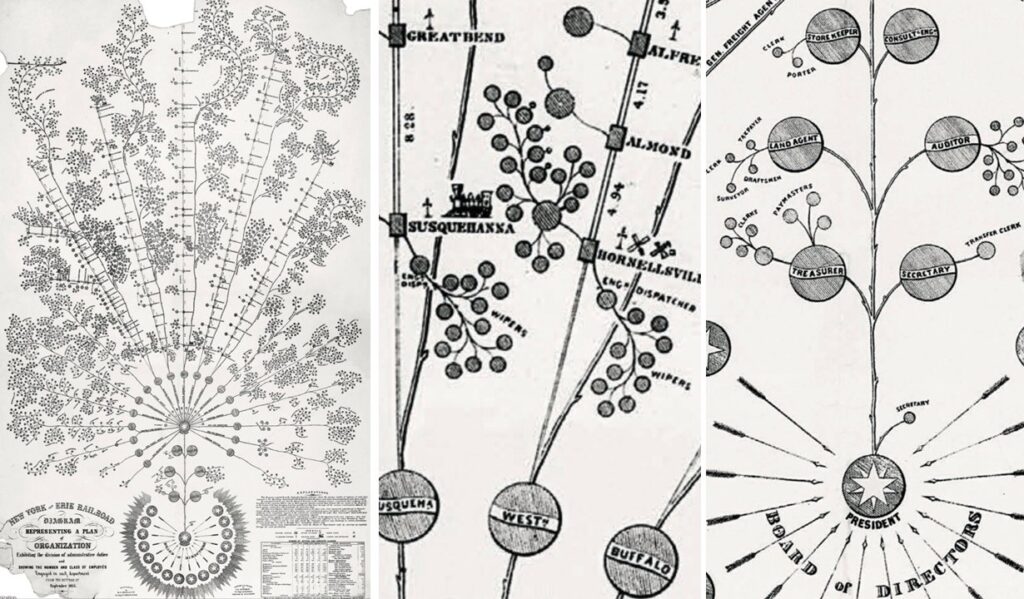
McCallum did not draw a pyramid. He drew a tree. The president and the board of directors sit at the bottom, as roots. The five operating lines rise as branches, and the people doing the actual work, the station keepers, dispatchers, engineers, and wipers, spread outward as leaves at the widest edge of the diagram.
The first org chart in American business put the front line at the outside edge and the authority underneath, as the thing the whole structure grew out of.
“That is uncomfortably close to what this paper is about to argue for, one hundred seventy years later.”
What we inherited is not McCallum’s tree. The tree was forgotten for most of a century and only rediscovered in recent decades. What survived and spread was the pyramid, the version that stacks authority upward and pushes information through layers, and that is the shape sitting in every dealership today.
The trap has held ever since. Narrow the span of control and you add layers, which slows information down. Widen it and you overload the manager, which degrades decisions. Every organizational idea since has tried to work around that tradeoff rather than break it, and companies revert to hierarchy as they grow because nothing else has ever been strong enough to do what hierarchy does.
“Our industry has had its McCallum moment, but most of us never named it.”
The DMS did to the dealership what the org chart did to the railroad. It took the department structure that already existed, encoded it into software, and then standardized its financial statement on top of that encoding. New, used, F&I, service, parts, body. Gross attributed by department. Pay plans written against department gross. Managers measured on department lines.
That is why the dealership org chart has barely moved in fifty years while almost everything else about the business has. It is not tradition and it is not stubbornness. The structure is enforced by the accounting, and the accounting is enforced by the manufacturer.
It is also why bolt-on AI tools became the default. When the structure cannot move, the only thing left to do is to put new technology on the outside of it.
So the real question is not whether AI can help a department. It is whether the coordination work that all those layers exist to perform can be done by something else. That is what would make a store native rather than augmented.
You already believe in this. Yours is just monthly.
The term at the center of this paper is world model, and it is worth removing the mystery from it immediately.
A world model is a live representation of a business that something can reason over. Not a report. Not a dashboard. A working picture of the state of things, updated continuously, and complete enough that a decision can be made from it without asking anyone.
Every dealer in a 20 Group already believes in this idea. You have been operating a primitive version of it for decades.
“The composite is a world model. It is a representation of your store, built to make decisions from, benchmarked against reality.”
You trust it enough to change pay plans, staffing, and inventory strategy based on what it says. It just has three limitations you have quietly accepted:
- It refreshes monthly.
- It aggregates to the department line.
- It cannot see a single VIN or a single household.
Now imagine the same data, continuously updated instead of monthly, at the level of the individual unit and customer instead of the department. That is the whole idea. Nothing about it is foreign to this business. What is new is that the refresh rate and the resolution are no longer limited by how fast a person can compile it.
This is also why “we already have plenty of data” is the most dangerous sentence in a dealership right now. Data is inert. It is a record of what happened. A world model holds the current state and can be reasoned over. Most stores are drowning in the first and have none of the second. Unfortunately, the abundance of the first is exactly what convinces them that they are covered.
Three constraints that are ours alone
Software companies are rebuilding themselves around this idea right now, and their playbooks are circulating. Do not run theirs. A dealership faces three unique constraints, and each one changes the order of operations.
One. Almost nothing a store knows is written down.
In a software company, almost everything anyone does leaves a written record a computer can read. Decisions live in documents. Discussions live in threads. Work lives in tickets. Data memory builds itself as a side effect of how people already work.
A dealership is the complete opposite case.
The highest-value decisions in a store happen out loud and then disappear. The used car manager’s read on a trade. The advisor’s judgment about which declined item to press and which to let go. The walkaround. The phone call. The conversation at the desk that decides whether a deal lives. None of it is captured. None of it is queryable. It exists in the heads of people who go home at six and are gone inside of two years.
What does get recorded is scattered across six or eight systems the dealer does not own, visible only through screens, and impossible to look at all put together.
“Cut the coordination layer before you build the memory and you have not replaced the hierarchy with intelligence. You have deleted the only place the intelligence was living.”
This is the single most important sequencing point in the paper. Memory first. Structure last. Any program that reverses that order will fail in an obvious and public way.
There is a test for this that some readers will recognize. If your understanding of your own store walks out the door when a vendor relationship ends, you never owned a world model. You were renting a view of one.
Two. A dealership rents nearly all of its capabilities.
List the things a store actually does. Acquire a unit. Price it. Recondition it. Quote a payment. Get a lender decision. Book a deal. Order a part. Open an RO. Dispatch a technician. Submit a warranty claim. Compute a customer’s equity position.
Those are your primitives, the basic operations everything else is built out of. Every one of them is real. Almost none of them are actually owned by the store. They are features inside vendor products, reachable only through that vendor’s screen, on that vendor’s terms, at that vendor’s price, with that vendor’s permission. Some cannot be called at all. Some can be called but not written back to. Some can be called only by other vendors who have paid for the privilege of touching the dealership’s data.
“You cannot compose capabilities you cannot digitally access.”
This is where ownership stops being philosophical and becomes an engineering constraint. The reason a dealership cannot go native today is not that the models are not good enough. The models are fine. The reason is that the store has no programmatic access to its own operations, and everything downstream of that is a demonstration rather than a system.
Any dealer serious about this has to answer one question before writing another check: which of these operations can my own systems call directly, and which are locked inside somebody else’s product?
Three. The org chart is enforced by the financial statement and paid for by the pay plan.
A native store needs someone who can own an outcome that crosses departments. Call it what you want. Owner of customer defection in the 2023 delivery cohort, ninety days, full authority across service, sales, and F&I.
That role produces enormous value but today, it has nowhere to live. There is no account for it on the factory statement. There is no department for its gross. There is no line for its expense. The financial statement has no shape for a person who owns a customer rather than a department.
And there is a second problem underneath it.
“In a dealership, the hierarchy is not only routing information. It is clipping gross.”
Every layer of the org chart is encoded in a compensation plan that takes a percentage. Which means the coordination layer will defend itself economically, not just culturally. That is not resistance to change. It is a rational response to a threat to income, and it should be treated with respect rather than frustration.
The conclusion follows directly. You cannot change the structure until you change how people are paid. Compensation design is not an adjacent workstream in this shift. It is the load-bearing wall.
What AI native actually looks like
With those constraints established, the architecture is straightforward. Four layers, built from the bottom up, because each one depends on the layer beneath it.
Capabilities. Acquire, price, recondition, quote, decision, book, order, dispatch, repair, deliver, fund. These are not products and they have no screens of their own. They are the operations the store performs, exposed so that something other than a human at a keyboard can call them. They carry reliability and compliance requirements, not user experience ones.
World model, two sides. The store model holds the state of the business. Every unit with its age, cost, recon status, and floor plan clock. Technician capacity by skill and by hour. Advisor load. Parts on hand and on order. Open ROs and their aging. Deal pipeline and gross accrual. This is precisely the information the 8 a.m. meeting was invented to produce, except it is produced continuously and nothing gets left out on the way.
The customer model holds the state of the relationship. Per VIN and per household: equity position, service history, declined work, warranty and plan status, mileage trajectory, term and maturity, contact history, and who in the household drives what.
There is a signal advantage here that belongs to dealers and almost nobody else. The most honest signal in this business is the vehicle. Lower frequency than a credit card transaction, far higher value per event, and it persists for years. Every repair order is a fact about a person’s relationship to a forty thousand dollar asset. And you observe the entire ownership lifecycle rather than a single moment, from both sides, as the merchant. Very few businesses in any industry have a vantage point that good and use it that poorly.
Intelligence layer. This is what composes capabilities into a specific action for a specific customer at a specific moment. It is the layer that replaces the list. Nobody pulls equity mining. Nobody runs a declined-service report. The composition is the list.
Interfaces. The lane tablet, the phone, the text thread, the website, the desk. Delivery surfaces. Important, but not where the value is created.
That last point is uncomfortable and it should be. If you believe your website or your CRM is your competitive asset, this architecture says otherwise. Those are windows. The value is in what’s behind them, and if what’s behind them belongs to somebody else, so does the value.
The roadmap inverts. When the intelligence layer tries to compose an action and cannot, because parts availability is not visible, or warranty labor operations are not exposed, or a lender decision requires a human keystroke, that failure is the roadmap. Customer reality generates the build list directly, instead of a vendor or a committee guessing at it. The gaps tell dealers what to buy, which is a far better basis for technology decisions than a demo.
The same Tuesday, both ways
A 2022 Explorer crosses 36,000 miles. Brake service was declined twice, most recently in March. The lease matures in four months. The store is two units short on that trim in used inventory, which pushes the equity position to positive by roughly $3,100. A factory pull-ahead is currently live. The household has a second vehicle approaching its own maturity next spring.
Six facts. All of them already exist in your store today.
The bolt-on AI tool version. The equity mining tool runs its monthly pull and produces a list of 340 names. The Ford Explorer is on it, ranked forty-first. A BDC agent works down from the top and reaches it on Thursday with a generic trade message. Service never hears about it, because service runs on a different tool with a different list. The brakes stay declined. If the customer answers and shows interest, someone starts looking for a unit, and the trim shortage that made the equity attractive in the first place is discovered two days later.
The native version. The intelligence layer composes one thing: a service appointment that carries a trade conversation, a specific stock number already on the ground, a payment within a few dollars of what they pay now, and the brake parts pre-ordered in case they decide to keep it.
No list was pulled. No campaign was scheduled. The customer receives one relevant thing at the moment it is relevant.
Count what that single action touched: service, parts, used inventory, F&I, and sales. Five departments, one moment. And notice that under the current financial statement, there is no clean way to say who owns it, who gets paid for it, or where the gross lands. That is the third constraint, in real-time. The architecture works. The store’s accounting just does not know what to do with that architecture yet.
The reorg, honestly
Outside of automotive, this shift is being executed as a headcount reduction. Do not import that framework. It does not fit a dealership and it will get a program killed in week one.
Software companies cutting deeply had thousands of people whose entire function was coordination. A dealership has the opposite problem. Not enough technicians. Not enough recon throughput. Not enough people to take the walk-in properly. The constraint in retail automotive is the capacity to touch cars and customers, and it’s been that way for years.
“The store version of this is not a headcount reduction. It is the same payroll, placed differently.”
In a typical store, a meaningful share of total headcount spends its day routing, list-building, keying, reporting, and chasing status rather than touching a customer or a car. Move that capacity to the edge. Do not delete it. An advisor who stops assembling call lists and starts working the lane is worth more, not less. A manager who stops compiling and starts coaching is worth more, not less.
That is both the honest read and the only version a dealer will actually execute. One role does have to be invented though.
A dealership has a controller because money requires a dedicated custodian with standing and independence from the departments being measured. The model now needs the same thing. Someone whose job is the store’s representation of itself: its accuracy, its coverage, its consent posture, its ownership. Someone who reports to the dealer, sits at the same level as the controller, and is not measured on any single department’s gross.
That role does not exist on a single dealership org chart in the country today. Within five years it will be as normal as the controller, and the stores that create it first will have a compound advantage that cannot be purchased later.
What stays human, permanently
A model that cannot touch the world is just a database, and that is more literally true in our business than in most.
Someone hands over the keys. Someone does the walkaround. Someone diagnoses the noise the customer cannot describe. Someone reads the room when a customer is looking at a $2,800 estimate and deciding whether they trust the store’s staff. Someone makes the judgment call that a model should not be making on its own, especially when the situation is novel or the cost of being wrong is severe.
“The edge is not where the leftover work goes. The edge is where the value is realized.”
There is also a compliance floor, and it is permanent.
An intelligence layer that proactively composes and delivers a credit-related offer runs directly into ECOA and adverse action requirements, TILA advertising rules, GLBA privacy obligations, the FTC Safeguards Rule, and consent-to-record law that varies state by state. Don’t forget to add manufacturer requirements on top of the federal layer.
The model can identify the moment. It cannot originate the offer unsupervised. Treating that gate as a permanent design requirement rather than a temporary obstacle is what separates a serious program from a reckless one. Ask any vendor where the human approval gate sits, and be concerned by an answer that treats the question as friction.
Compliance is an argument for this, not against it
It is worth being precise here, because a lot of dealers have the regulatory picture wrong in a way that costs them money.
The Safeguards Rule is not pending and it is not optional. It has been on the books since 2003, the amended version took effect in June 2023, and the breach notification requirement followed in May 2024. Dealers are covered because arranging financing makes a store a financial institution, and dealers are the only financial institutions who also fall under the FTC’s Privacy Rule. Nothing about the rule changed in 2026. What changed is that the FTC stopped issuing guidance and started enforcing, with automotive dealerships a stated priority.
The rule most dealers are thinking of when they assume the pressure eased is a different one. The CARS Rule, which covered advertising and add-on disclosure, was vacated by the Fifth Circuit in January 2025 on procedural grounds. Some read that as a signal that federal scrutiny had lifted. In March 2026 the FTC sent warning letters to ninety-seven dealerships and made the names public that May.
Now connect that to the AI bolt-on stack, because this is the part nobody says out loud.
“Every bolt-on you add is another vendor holding customer data, another vendor oversight obligation under Safeguards, and another way to be breached.”
The Safeguards Rule requires dealers to oversee their service providers and hold them to the dealers’ security standards contractually. Eight tools, each one pulling a feed and enriching customer records on their own servers, is eight of those obligations. It’s eight sets of controls to verify without being able to see them, and eight places an incident can happen that will translate to a dealer’s name in the FTC notification.
An owned operational record inverts that math. When the memory sits in one place that a dealer controls, the surface shrinks instead of growing. Data access is the dealer’s to audit, and consent is recorded once against the customer rather than reconstructed across multiple agreements.
So the compliance argument does not cut against going native. It is one of the better reasons to start.
Purchasing in the meantime
Nobody is going native this quarter. Today, dealers keep buying, and most of the stack being sold is bolt-on with better branding.
Four questions separate a purchase that moves a store towards native. Ask them in this order, in writing, before the demo.
Can it read across departments, or only within one?
An AI tool that cannot see service history while it looks at equity is producing an uninformed recommendation, no matter how good the model behind it is.
Does it write back what it learns, into a store you control?
If the enrichment lives only on the vendor’s side, you are paying to improve someone else’s asset. This is the most valuable term in any dealer software agreement and almost nobody negotiates it.
If I cancel in eighteen months, what do I keep?
Run the swap test on the memory, not just the software. Keeping a data export is not the same as keeping the understanding.
Does it take an action, or does it hand a person a list?
Lists are not bad. But a list is a bolt-on signature, and you should price it as one rather than as a step toward something structural.
A vendor who answers all four well is worth a premium. A vendor who cannot answer the second one is selling you a rental of your own information.
Build order, with stop conditions
The sequence matters the most. Each step has a condition that must be true before the next one begins.
Most stores reading this paper will be somewhere before step two. That is not a failure. It is an accurate starting position, and knowing it is worth more than a strategy built on the wrong step.
The question
Strip away the architecture and one question is left. It is the one I would ask any dealer who wants to know where to start.
“What does your store understand that is genuinely hard to understand, and is that understanding getting deeper every day?”
If the answer is nothing, AI is a cost story for you. The store will cut some expenses, improve a few months of margin, and eventually compete against operators who understand their customers better than you understand yours, using an advantage you chose not to build.
If the answer is deep, then AI does not change what your store is. It reveals it.
A dealership sees things that almost no one else in the vehicle’s life sees. Both sides of the transaction. The condition of the asset over years. The household, not just the buyer. What the customer said yes to and what they said no to and when. That understanding compounds, and it compounds specifically for whoever holds it.
The only real question is whether it accumulates in a system you own, or in one you rent.
Appendix A. A note on the framework
Readers of my earlier work will recognize the four-layer structure here as a refinement of the AI Nucleus, which I have described as Data, Workflows, AI, and Digital Employees. I am revising the second layer, and I want to show the reasoning rather than quietly change the wording.
“Data” is the wrong name for that layer, and the wrongness is not cosmetic. Data is inert and historical. Every dealer already believes they have plenty of it, which is exactly why arguments built on that word bounce off. A world model is a live representation of the current state that a system can reason over. Naming it that way makes the gap visible to an operator who is otherwise certain they are covered.
The other three layers hold, and the intelligence layer is a sharper description of what I have been calling AI plus Digital Employees. Composition is the function. The employee metaphor describes the delivery.
Appendix B. The Swap Test, applied to memory
The Swap Test has been a useful tool for evaluating tooling: if you replaced this vendor tomorrow, what would you lose?
Applied to memory, it becomes more severe. If you replaced your DMS, your CRM, and your marketing platform tomorrow, what would your store still know about itself and its customers?
For most dealerships the honest answer is: whatever is in the heads of the people who happen to still work there. That is what this paper addresses.
Appendix C. This is not a theory anymore
The argument in this paper stands on its own inside a dealership, which is why the body of it stays inside a dealership. But readers who want to know whether anyone is actually operating this way should look at Block, the parent of Square and Cash App.
In February 2026 Block cut roughly forty percent of its workforce while the business was growing. In March, CEO Jack Dorsey and board member Roelof Botha published the reasoning in an essay called “From Hierarchy to Intelligence,” posted on Block’s site. Their claim is that hierarchy is an information routing protocol, and that for the first time a technology exists that can perform the routing. They describe the same four layers used here, in fintech terms rather than retail automotive ones.
Six months in, the operating numbers are more informative than the layoff number. AI is now involved in nearly every change to their production code, code changes per engineer are up sharply, and one product line shipped roughly three times the features it shipped a year earlier at meaningfully lower product development expense.
The skeptics deserve equal time. Several analysts and at least two economic studies have argued that layoffs attributed to AI across the industry were substantially corrections for pandemic-era overhiring, and Block’s own headcount had nearly tripled between 2019 and its peak. Both things can be true. The cuts may have been overdue regardless, and the architecture can still be right.
Nothing in this paper depends on how that experiment turns out. It is offered as evidence that the question lives outside our industry, and that the answer arriving here is a matter of timing rather than possibility.
The regulatory points in section nine come from the FTC’s own published guidance for auto dealers on the Safeguards Rule, and from reporting on the vacated CARS Rule and the March 2026 warning letters. All of it is public and worth reading directly rather than taking my summary of it.
Download The Dealership Nucleus
The full paper, with all eight figures, formatted for print and for your next leadership meeting.